
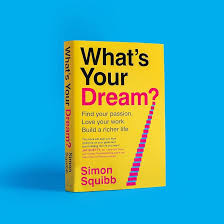
What If Schools Were Designed to Help Students Craft a Dream?
“The right question is more powerful than the right answer.”
— Simon Squibb, What’s Your Dream?
In What’s Your Dream?, Simon Squibb opens with a quiet rebellion; one that many educators feel instinctively but struggle to voice. He argues that schools are built on myths; that getting good grades leads to success; that following the rules guarantees stability, and that young people will find meaning if they simply do what they’re told.
These myths are tidy. But they’re also outdated.
In many of our classrooms, students are given content, rules, and a set of metrics to aim for. They’re not often asked:
What matters to you? What do you want to build? What do you want to solve?
We don’t just avoid these questions; we’ve structured education to actively delay them.
How?
A focus on exam-readiness has narrowed what education is allowed to be. In too many systems, performance is mistaken for purpose. Academic credentials are mistaken for capability. And curriculum content becomes a proxy for identity. The more I read and hear, the more I get drawn back to Sir Ken Robinson’s TED Talk, “Do Schools kill creativity?” Having watched this in my first days as a teacher, it is remarkable how many times I have rewatched, and referenced this video in 15 years. Simon Squibb and many others, iterate the same problem through different lenses.
This is not a new criticism nor has it changed; what has changed is the world around us. Students are coming of age in a landscape of climate instability, AI disruption, political polarisation, and economic uncertainty. They don’t need more answers. They need stronger questions, deeper thinking, and permission to imagine alternative futures.
And yet, we still build systems that reward memorisation, speed, and compliance — all measurable in a test, none essential to a meaningful life.
The Missed Opportunity
What if we embedded opportunities for students to articulate their dreams — not as a one-off careers week, but as a sustained practice across disciplines? What if identity formation was treated as a core part of academic development?
A Structural Question
We need to address the uncomfortable truth that schools, as we know them, are compliant themselves to the system. How many do we know are changing the narrative; the course of education? The continued existence of discipline systems, and rigid curriculum compliance reflects a post-colonial mindset: one that values order over empowerment, hierarchy over autonomy.
We did work hard to advocate for student agency; we worked hard to give every child their rights, but did we work hard enough to give every child the space to speak their dreams and cultivate them?
If students are to leave school ready to lead, adapt, and contribute meaningfully to the world — they must first be given space to imagine themselves as agents of change. That begins with the questions we ask, and the systems we build around those questions.
A Challenge to Schools
What if school was a place to craft your dream — not just a factory for grades and credentials?
This isn’t slander to the current system, nor is it a call to abandon rigour. It’s a raising hand to restore meaning. To teach academic content within a broader architecture of purpose, self-awareness, and ethical responsibility.
Because in the end, education isn’t about producing graduates who can replicate models.
It’s about raising thinkers who are equipped — and brave enough — to design new ones.

Leave a comment